Description
Review of the Ernie Ball How to Play Guitar Phase 1 Book
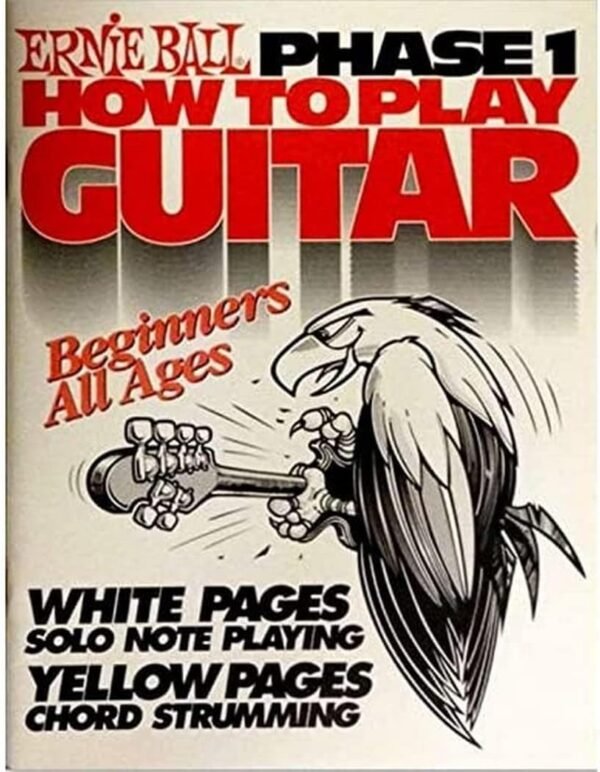
The Ernie Ball How to Play Guitar Phase 1 Book is a printed beginner method book rather than an instrument or an accessory. The listing describes it as easy to follow, suitable for self teaching or for use alongside lessons, and built around single note and chord instruction. It is aimed at someone who has just acquired a guitar and wants a structured starting point away from a screen.
Pros & Cons
Pros
- Covers both single notes and chords, which is the right combination. Chords alone leave a player unable to pick out a melody, and single notes alone leave them unable to accompany anything.
- Works for self teaching or alongside a teacher, so it does not become redundant if lessons start later.
- Printed format, which means no notifications, no autoplay and no battery. A book sits open on a music stand and stays on the page it was left on.
- Large page size at 8.5 by 11 inches, which is the standard sheet music format and easier to read at arm’s length on a stand than a paperback.
Cons
- The listing gives almost no detail about the contents. There is no page count, no chapter list and no statement of whether the material is written in tablature, standard notation or both.
- A book cannot hear the reader. Nothing in a printed method corrects bad fretting hand posture or a hand position that will cause problems later, which is where a teacher earns their fee.
- No audio or video accompaniment is listed, so rhythm and timing have to be judged by the reader alone.
- The specification table carries guitar fields such as number of strings, which do not apply to a book and should be ignored.
Detailed Product Description
This is a physical book measuring 8.5 by 0.25 by 11 inches and weighing 6.5 ounces, carrying the Ernie Ball model number P07001. The dimensions are the useful part of that data. At 8.5 by 11 inches it matches standard letter and sheet music sizing, which means it opens flat on a music stand and the notation is printed large enough to read from playing position rather than from reading position. At a quarter of an inch thick it is a slim volume, consistent with a first stage book in a series rather than a comprehensive tutor.
That third point is worth unpacking, because it describes the two separate skills a beginner has to build. Single note playing is the foundation of melody, scales and lead work, and it trains the fretting hand to place one finger accurately. Chord playing is the foundation of accompaniment and songwriting, and it trains the hand to place three or four fingers simultaneously in a shape. Beginners who learn only chords often find they cannot play a melody at all, and beginners who learn only single notes often find they cannot play along with anyone. A method that runs both in parallel avoids that gap.
Beyond those points, the listing does not describe the material. Anyone who needs to know whether the book teaches standard notation, tablature or both, how many lessons it contains or what songs are included should confirm that with the seller before buying, because the listing data does not answer it.
What Comes with the Product
- The How to Play Guitar Phase 1 book, model P07001
No CD, DVD, download code, poster, picks or strings are listed as part of the package. It is the printed book alone.
Who It Suits
This suits a beginner who already owns a guitar and wants a structured path through the first stage rather than a random sequence of online videos. It suits a self teaching adult particularly well, because a printed book imposes an order on the material that video browsing does not. It also suits a student already taking lessons, as supplementary practice material between sessions.
It suits less well someone who does not yet own a guitar, since a method book on its own has nothing to be practised on. Anyone at that stage should start with a complete package such as the Yamaha GigMaker Standard or the ADM dreadnought acoustic kit, which bundle an instrument with the accessories needed alongside it. It also suits less well a learner who needs to hear the material demonstrated, since no audio is included. Someone in that position may prefer an instrument that ships with structured lessons, such as the Yamaha URBAN guitar with its lesson app. Younger children who cannot yet read music notation will get more from a teacher than from any book. The wider selection sits in the full guitar review index.
How to Maintain
Avoid cracking the spine flat to make it stay open. Use a music stand with a page clip or a pair of small clothes pegs instead, which keeps the pages open without destroying the binding.
Pencil rather than pen for annotations. Marking up fingerings and problem bars is one of the most useful things a learner can do with a method book, and pencil can be corrected as understanding improves.
Tips and Recommendations
Work through the book in order rather than skipping to the interesting pages. A method book is sequenced deliberately, and the exercises that look dull are usually building the hand strength or finger independence that a later page assumes.
Keep sessions short and frequent. Twenty minutes daily produces far more progress than three hours once a week, because the hand movements being learned are physical habits. The guide to a beginner guitar practice routine sets out a workable structure.
Set realistic expectations about the pace of progress. The guide to how long it takes to learn guitar covers what the early months usually look like, which is worth reading before frustration sets in.
Product FAQ
Is this a book or an instrument?
It is a printed method book. No guitar is included.
What does it teach?
The listing states single note and chord instruction, and describes the book as suitable for self teaching or for use with lessons.
Does it come with a CD or video?
Nothing beyond the book is listed as included.