



Description
Review of the Kadence Frontier Acoustic Guitar FNTR-C 40 Inch with Die Cast Keys
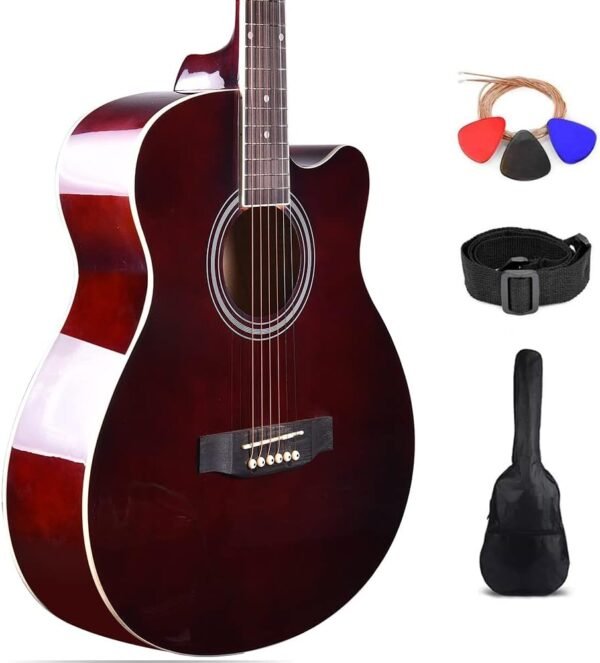
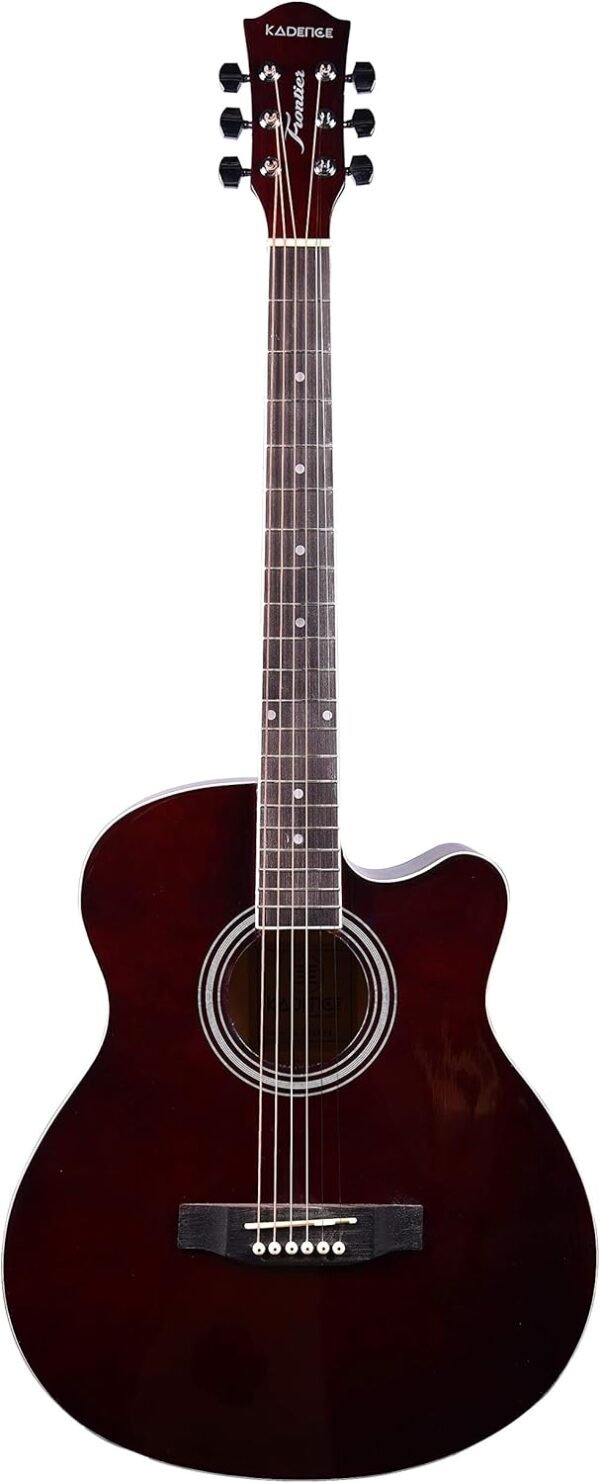
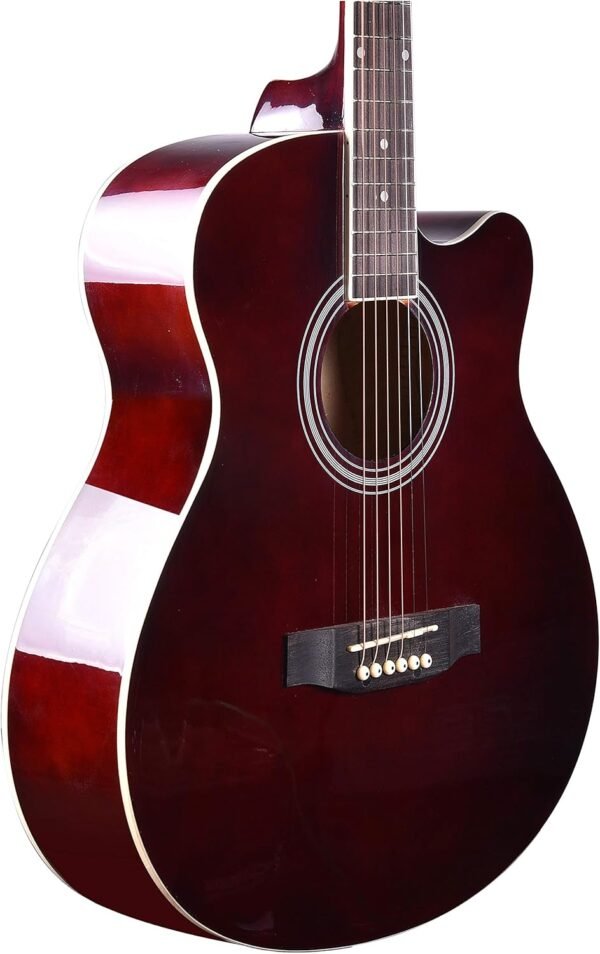
The Kadence Frontier is a cutaway steel string acoustic with a spruce top, a rosewood fingerboard and an Indian rosewood bridge, finished in high gloss and supplied with a strap, spare strings, picks and a carry bag. The manufacturer positions it for players aged roughly ten and above, particularly beginners and students. It sits in the acoustic guitars range as a mid entry option rather than a bare bones starter.
Pros & Cons
Pros
- A built in truss rod is specified. This is the feature that decides whether a budget acoustic stays playable. A truss rod lets neck relief be corrected as the wood responds to string tension and seasonal humidity, rather than leaving a bowed neck permanently high and hard to fret.
- The bridge is Indian rosewood. Rosewood is dense and hard, which lets it transfer string vibration into the top efficiently rather than absorbing it. A soft bridge is a common weak point at this price.
- The strings are bronze coated. A coating slows the corrosion that dulls acoustic strings, so the supplied set should stay bright longer than uncoated strings would.
- Die cast tuning machines are named in the title. Die cast tuners have an enclosed gear housing that holds lubrication and resists slipping, which is a genuine step up from open press fit tuners.
- The cutaway gives upper fret access and accessories are bundled. The shaped upper bout lets the fretting hand reach frets a full shoulder blocks, and a strap, spare strings, picks and a bag cover the immediate needs without a second purchase.
Cons
- The listing contradicts itself on size. The product title and the manufacturer description both say 40 inch, while the spec table size field says 39. Package dimensions are given as 42.5 inches. Three different numbers describe the same guitar, and none of them is the scale length a buyer would actually want.
- The spec table lists a Guitar Pickup Configuration of S. Nothing else in the listing mentions a pickup, a preamp, an output jack or a battery. This should be treated as a purely acoustic instrument with no amplified output.
- The body wood is described inconsistently. The spec table gives spruce for the body and the top but rosewood for the back, while the title says a spruce wood finish. A spruce back would be unusual, and “spruce wood finish” suggests a spruce appearance rather than spruce construction. The listing never resolves whether the back and sides are rosewood, spruce, or a laminate with a spruce look.
- Solid or laminated construction is never stated, and neither is fret count or nut width. Solid against laminate is the specification that most determines how an acoustic sounds and how it improves with age, and all three figures are absent.
- The colour field reads FRSBC. That is an internal product code rather than a colour, and the only colour reference anywhere in the listing is brown in the title.
Detailed Product Description
The top is spruce, which is the standard choice for a steel string acoustic. Spruce is stiff for its weight, so it moves readily under string energy and produces a clear, articulate sound with a strong attack. Whether this top is a solid piece or a laminate makes a large difference to that behaviour, and the listing does not say. The guide on solid top versus laminate acoustic guitars covers what changes between the two.
The scale length is given as 25.6 inches, which is a standard full size acoustic scale. That figure is more useful than the 39 or 40 inch overall length numbers, because scale determines string tension and how far apart the frets sit. At 25.6 inches the strings are under normal tension for a steel string set, so a beginner should expect the usual sore fingertips for the first fortnight.
The neck carries a rosewood fingerboard. Rosewood is dense, oily and dark, holds frets securely and needs no finish coat. The neck wood itself is listed only as wood, with no species given. The finish is high gloss with what the manufacturer calls a streamlined cutaway curvature, meaning the neck to body transition is smoothed rather than abrupt.
What Comes with the Product
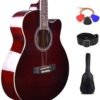
The listing states the guitar ships with a strap, a set of strings, picks and a bag.
Not included and not mentioned anywhere in the product data: a tuner, a capo, a stand, a string winder, a cleaning cloth, a hard case and any lesson material. A clip on tuner is the most important omission, because a guitar that is out of tune teaches the wrong pitches from the first session. The bag is described only as a bag, with no indication of whether it is padded, so buyers carrying the instrument regularly should check before relying on it for protection. No amplifier is included and none is needed, since no electronics are documented.
Who It Suits
This fits a beginner or student aged around ten and up who wants a full size steel string with a cutaway and a truss rod, and who values the accessory bundle. The truss rod and die cast tuners are the two specifications that make it a more sensible medium term choice than the very cheapest acoustics.
It does not suit a young child, for whom a full scale steel string is too large and too high in tension. It does not suit anyone who needs to plug into a PA or amplifier, since no electronics are documented. Players who want that from the same manufacturer should look at the Kadence A06 EQ electro acoustic or the Kadence Frontier FR01 EQ instead. The Rosen G11 41 inch acoustic is a comparable non cutaway alternative.
How to Maintain
Wipe the strings and fingerboard down after each session. Coated strings resist corrosion better than uncoated ones but still collect skin oils, and the coating does not help once residue builds up underneath. Keep the guitar out of direct sunlight and away from radiators, and store it in its bag when the room is unheated, since a spruce top responds to humidity changes by expanding and contracting, which is what shifts the action.
Use the truss rod only when there is a clear reason: rising string height, or buzzing on open strings. Adjust in small increments of roughly a quarter turn and let the neck settle for a day between adjustments. If the guitar will sit unplayed for months, slacken the strings slightly. The guide on how often to change guitar strings covers when the supplied set has reached the end of its life.
Tips and Recommendations
Add a clip on tuner as the first purchase alongside the guitar. It is the cheapest accessory and the one that most affects whether early practice sounds right.
Expect frequent retuning for the first week or two while a new set stretches, then far less. Keep the spare set unopened until the originals sound dull. A capo is the next most useful addition, because it lets a beginner play songs in different keys using the chord shapes already learned rather than attempting barre chords too early. Check the string height at the twelfth fret after the first month, since a new instrument settles once the strings have been under tension for a while.
Product FAQ
Is this guitar 39 or 40 inches?
The listing gives both. The title and description say 40 inch, the spec table size field says 39, and the package is listed at 42.5 inches. The scale length of 25.6 inches is the figure that actually describes the playing dimensions.
Can it be plugged into an amplifier?
No electronics are described anywhere in the listing. The single coil pickup entry in the spec table is not supported by the description, the title or the accessory list.
Are the back and sides rosewood or spruce?
The listing is inconsistent. The spec table gives rosewood for the back and spruce for the body, while the title describes a spruce wood finish. Only the rosewood bridge and rosewood fingerboard are stated unambiguously.
Does it come with a tuner?
No. The bundle is listed as a strap, strings, picks and a bag. A tuner would need to be bought separately.