
A capo clamps across the strings at a chosen fret, shortening the vibrating length of every string at once and raising the pitch of the whole guitar. Each fret you move it up raises everything by one semitone, so the chord shapes you already know produce a different key without you learning anything new.
That is why singers and songwriters reach for one constantly. It lets you keep the ringing open strings that make an acoustic guitar sound full, in keys where those open shapes would otherwise be unplayable. It is a small clamp that does a large amount of work.
Key takeaways
- One fret equals one semitone. A capo at the second fret turns a G shape into an A, and a C shape into a D.
- The main use is matching a song to a singer’s range without changing chord shapes.
- Place it just behind the fret wire, not on top of it, and use the least tension that stops the buzz.
- Check tuning after fitting a capo. Too much clamping force pulls strings sharp, especially the wound ones.
- Curved capos suit radiused steel string fretboards. Classical and nylon string guitars have flat fingerboards and need a flat capo.
What a capo actually does
Fretting a string shortens the part of it that vibrates, and a shorter vibrating length means a higher pitch. A capo does that to all six strings at the same point, so it behaves like a movable nut. The guitar is now, in effect, a shorter instrument tuned higher.
Because the relationship between the strings is unchanged, every shape you know still works. Play the fingering for a G major chord with the capo at fret two and the sound that comes out is an A major. At fret four it is a B major. Nothing about your left hand changes.
Here is the arithmetic in practice, using the shapes most beginners learn first:
- Capo at fret 1. C shape sounds as C sharp, G shape as G sharp, D shape as E flat.
- Capo at fret 2. C shape sounds as D, G shape as A, D shape as E, A minor shape as B minor.
- Capo at fret 3. C shape sounds as E flat, G shape as B flat, E minor shape as G minor.
- Capo at fret 5. C shape sounds as F, G shape as C, D shape as G.
When to use one
To fit a singer’s range. The most common reason by far. If a song sits too low, move the capo up a fret at a time and sing the chorus until it lands comfortably. This is far quicker than transposing the chords on paper.
To keep open strings ringing. Playing in E flat or B flat without a capo means barre chords everywhere, and barre chords do not ring the way open shapes do. A capo lets you play those keys with the open voicings that give an acoustic its character.
To brighten the tone. Capoing high on the neck produces a tighter, more mandolin like sound that cuts through a mix. This is a deliberate colour choice, not just a convenience.
To layer two guitars. Two players in the same key, one open and one capoed at fret five playing different shapes, produce a much bigger sound than two people playing identical parts.
To avoid a difficult barre while you are learning. This one is fine in the short term and a trap in the long term. Use it to get through songs now, but keep working on the barre chords separately.
Types of capo
- Trigger or spring capos. Squeeze and clamp, one handed, fast to move mid song. Tension is fixed, so they occasionally pull strings sharp on a low action neck.
- Screw capos. A thumbscrew sets the tension precisely, which is the most tuning friendly design. Slower to reposition.
- Toggle or strap capos. A strap wraps behind the neck and hooks into notches. Cheap, light, and awkward to adjust in a hurry.
- Rolling or shubb style capos. A lever mechanism with an adjustable screw, combining speed with controlled tension.
- Partial capos. Cover three or five strings instead of six, producing open tuning style drones without retuning.
Fretboard curvature decides the shape you need. Steel string acoustics and electrics have a radiused fretboard, so the capo pad is curved to match. Classical guitars have a flat fingerboard and a wider neck, and a curved capo on a flat board presses the middle strings harder than the outer ones. The construction differences are covered in nylon vs steel string guitars.
Fitting it without ruining your tuning
Position the capo just behind the fret wire, as close to it as you can without sitting on top of it. Too far back from the fret and the strings buzz. Directly over the wire and the notes choke.
Keep it straight and parallel to the fret. A capo at an angle presses unevenly and produces one or two dead strings. Use only enough tension to stop buzzing, because excess force stretches the strings sideways and pulls them sharp, an effect most obvious on the low E and A.
Always check tuning after fitting a capo, and check it again after removing one. If your guitar goes noticeably sharp every time you clamp it, the action may be high or the capo tension too aggressive. Both are covered in guitar action and setup explained, and the tuning routine itself is in how to tune a guitar.
Guitars and bundles that include a capo
Capos are cheap on their own, but many beginner packages already have one in the box. These entries from the review library do.
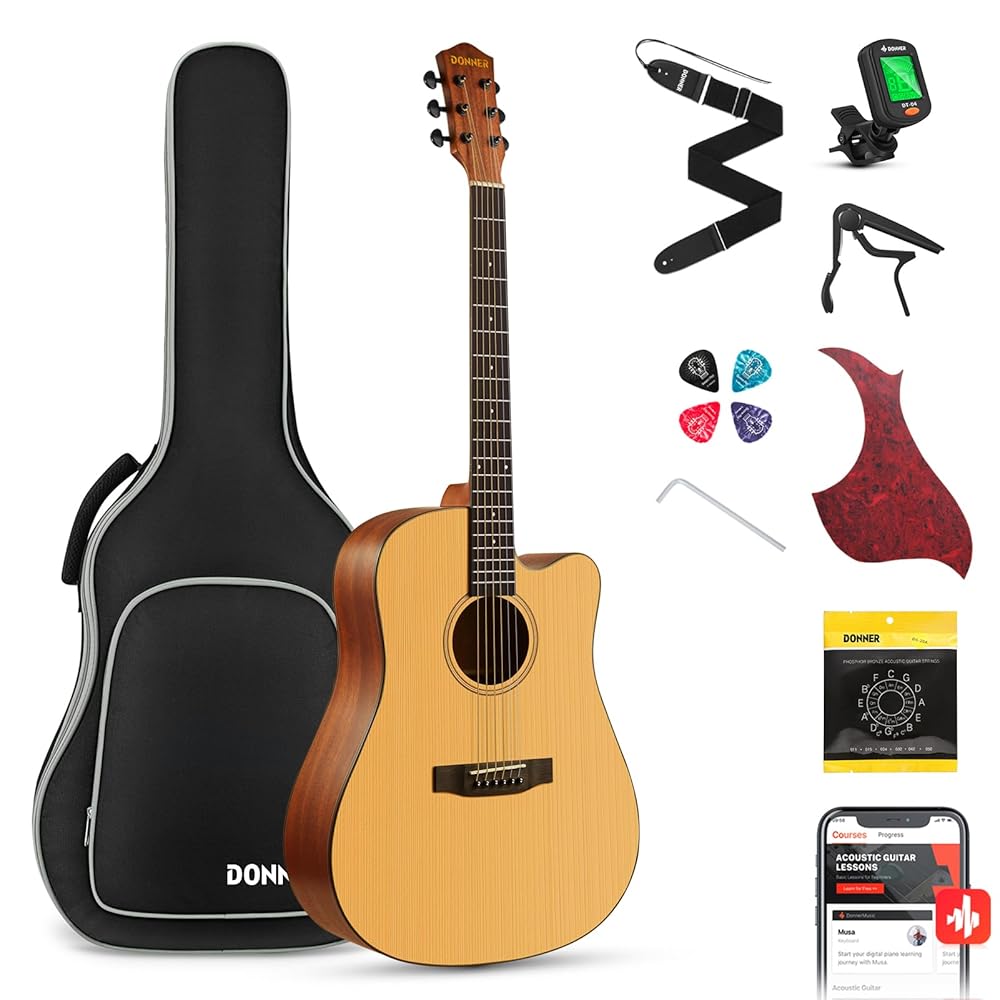
- Donner DAG-1C 41 inch acoustic bundle. A full size cutaway steel string supplied with a capo, padded gig bag, tuner, strap, picks and spare strings. A sensible all in one for an adult or older teen starting from nothing.
- WINZZ Hand Rubbed Series acoustic starter bundle. Includes a capo, clip on tuner, padded gig bag, picks, strap, a chord reference and a stand. Suits a beginner who wants the stand and the chord chart alongside the capo.
- ADM 41 inch dreadnought acoustic kit. Comes with a capo, waterproof padded gig bag, digital tuner, spare strings, strap, picks and a music stand. A good match for a teen or adult who will be reading from sheet music or a tablet.
- Donner DST-152 electric guitar kit. An HSS electric supplied with an amplifier, gig bag, tuner, capo, strap and picks. The electric option, useful because capos work exactly the same way on an electric neck.
Browse more of these in the acoustic guitars section, and see guitar accessories a beginner actually needs for the rest of the shortlist.
Frequently asked questions
Does using a capo mean you are cheating?
No. A capo is a tone and key choice used by professional players constantly, and plenty of recorded parts cannot be played without one. The only version worth avoiding is relying on it permanently to dodge learning barre chords.
Can you use a capo on an electric guitar?
Yes, and it works identically. Electric necks are usually narrower and flatter than acoustic necks, so a capo designed for an electric is a better fit than a wide acoustic model. Low action electrics need light tension or the strings go sharp.
Where exactly should the capo sit on the fret?
Just behind the fret wire, as close as possible without covering it. That position needs the least clamping force to stop buzzing, which keeps the tuning stable. Sitting halfway between two frets forces you to over tighten it.
Will a capo damage the neck or the strings?
Not in normal use. Leaving a heavily sprung capo clamped on for weeks can mark the finish and puts constant pressure on the strings at one point, so take it off when you finish playing. Keep the rubber pad clean, since grit trapped underneath scratches the fretboard.