Match the guitar to the child’s height, not their age. As a working rule, children under about 4ft need a 1/2 or 3/4 size instrument, children between roughly 4ft and 4ft 9in are comfortable on a 3/4, and most children over about 4ft 9in can handle a full size guitar.
Age charts are everywhere online and they are a poor guide, because two nine year olds can differ by a foot in height and by a lot more in arm length. The test that matters is whether the child can reach the first fret with a relaxed left arm while sitting with the guitar on their leg. If they have to stretch or lean, the guitar is too big.
Key takeaways
- Size the guitar by height and arm reach, not by the child’s birthday.
- 3/4 size is the most useful size for primary school age children and covers the widest range.
- Nylon strings are gentler on young fingertips than steel strings.
- A guitar that is too big does not build skill faster. It teaches poor hand position and gets abandoned.
- Under about age six, a three string guitar or a very small nylon string instrument is more realistic than a scaled down six string.
What the size numbers actually mean
The fractions describe scale length, which is the distance from the nut to the bridge saddle. A shorter scale means the frets sit closer together, so a small hand can span a chord shape without straining. It also means less string tension, so the strings press down more easily.
The fractions are approximate rather than exact ratios, and different brands measure them differently. A 3/4 acoustic from one maker can be noticeably larger than a 3/4 from another. Where a listing gives an overall length in inches, that figure is often more useful than the fraction. A 30 inch guitar, a 34 inch guitar, a 36 inch guitar and a 38 inch guitar are all sold under overlapping size labels.
Body depth matters as much as scale length and gets ignored. A dreadnought body is deep, and a small child has to reach over it before their strumming arm gets anywhere near the strings. A thinner or smaller body can make a guitar workable even when the scale length is on the long side.
A practical sizing guide by height
- Under 3ft 6in, roughly ages 3 to 5. A 1/4 size or a purpose built three string children’s guitar. Standard six string chords are beyond most hands this small.
- 3ft 6in to 4ft, roughly ages 5 to 7. A 1/2 size, often listed around 30 to 34 inches overall.
- 4ft to 4ft 9in, roughly ages 8 to 11. A 3/4 size, usually listed around 36 inches. This is the size most children spend the longest on.
- 4ft 9in and above, roughly age 11 upward. Full size, though a concert or parlour body will still be more comfortable than a dreadnought for a slight teenager.
Where a child sits between two sizes, go smaller. A guitar that is slightly small is still playable. A guitar that is too big produces a hunched posture, a cramped fretting hand and slow progress, and children rarely say the instrument is the problem. They just stop picking it up.
Nylon or steel strings for a child
Nylon strings are easier on young fingers. They sit under lower tension, the tone is soft, and a child can practise for longer before their fingertips complain. Classical necks are wider, which some small hands find awkward, but the comfort trade is usually worth it under about age ten.
Steel strings are brighter and louder and are what most pop and rock music sounds like. A motivated older child who wants to play current songs will often accept the sore fingertips for the sound they actually want. The full comparison is in nylon vs steel string guitars.
Electric is a legitimate option for children too, and small scale electrics exist for exactly this reason. Light strings and low string height make them easy to fret, and headphone practice keeps the house quiet.
How long a small guitar lasts before it is outgrown
A 1/2 size bought at six is usually outgrown by nine. A 3/4 bought at eight can last until twelve or beyond, and plenty of adults keep a 3/4 around as a travel guitar. That makes 3/4 the size with the best return on the money.
Do not buy large to postpone the next purchase. Beginners who cannot form a clean chord because the shape does not fit their hand tend to conclude they are bad at guitar. Getting the size right in the first year is what makes the second guitar happen at all. On spending, how much to spend on a first guitar covers where the sensible limits sit.
Four guitars sized for younger players
Each of these is covered in the review library, and each fits a different stage.
- Loog Mini suits the youngest starters, from around age three. It is a real wooden guitar with three nylon strings and low action, paired with an app and video lessons, which makes it practical where a six string is not.
- Yamaha CGS103AII suits a primary school child learning properly. It is a 3/4 size classical with a spruce top and nylon strings, so it is kind to fingertips while still sounding like a real instrument.
- Fender FA-15 3/4 suits an older child who wants steel strings and modern songs. It is lightweight for its class and ships with a gig bag, which matters if the guitar travels to lessons.
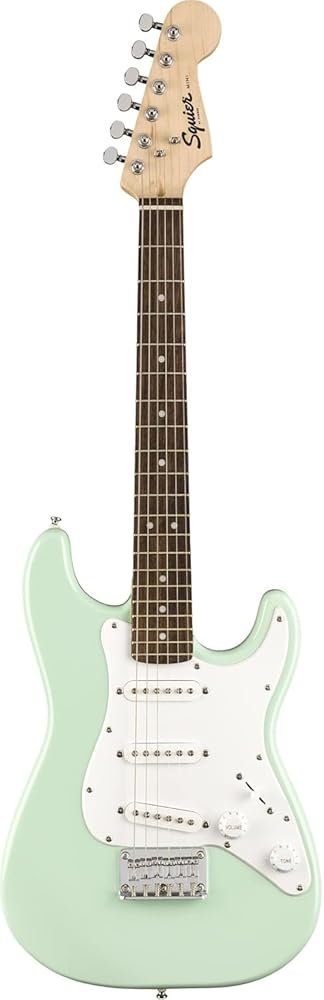
- Squier Mini Stratocaster suits the child who wants an electric. The short scale poplar body is easy to carry, the C shaped neck is comfortable, and the hardtail bridge keeps tuning steady through enthusiastic playing.
More options are listed under acoustic guitars and electric guitars.
Frequently asked questions
Can a child learn on a full size guitar to save buying twice?
It is possible for a tall eleven year old and a bad idea for a seven year old. The problem is not effort, it is geometry. If the fretting hand cannot reach the first three frets without the elbow locking straight, the child cannot form the chords that early lessons are built on, and progress stalls for a reason they will not be able to explain.
Are small guitars just toys?
Some are, and they are easy to spot. A real small guitar has a truss rod or a properly braced neck, geared tuners that hold pitch, and a bridge that intonates. Toys have painted on details, plastic tuners that slip, and strings that will not stay in tune long enough for a lesson.
What size does a child need for bass rather than guitar?
Bass scale lengths are longer than guitar, so a full size bass is out of reach for most children. Short scale and 3/4 size basses exist for this reason and are the sensible starting point. The short scale vs full scale bass comparison goes into the detail.
Does a child’s guitar need a setup?
It benefits from one more than an adult guitar does. Small hands have less strength, so high string height that an adult would push through can make a child’s guitar feel unplayable. Lowering the action is usually a small adjustment with a large effect.