
If you have small hands, look for a shorter scale length, a narrower nut width, and a slim neck profile. Those three measurements decide how far your fingers have to stretch and how far they have to reach around, and they matter far more than the size of the guitar body.
Small hands are not a barrier to playing guitar well. Plenty of accomplished players have short fingers. What does hold people back is starting on an instrument with a wide, chunky neck and a long scale, deciding the difficulty is their own fault, and giving up. Choosing the right dimensions removes that problem entirely.
Key takeaways
- Scale length sets fret spacing. Shorter scale means shorter stretches, which is the single biggest factor.
- Nut width sets how far your thumb has to reach around the neck. Narrower is easier for small hands.
- Neck profile, meaning the shape of its back, matters as much as width. A slim C profile is the usual recommendation.
- Body size affects comfort and reach to the first fret, but it is a secondary concern next to the neck.
- A good setup with low action reduces required finger pressure and makes any guitar easier to fret.
Scale length is the number that matters most
Scale length is the distance the strings vibrate, from the nut to the bridge saddle. It determines fret spacing across the whole neck, so a shorter scale puts every fret closer to the last one.
Full size acoustics usually sit around 25.5 inches, sometimes a little shorter at about 24.75, while three quarter size acoustics come in around 22 to 23 inches. Electric guitars split between roughly 25.5 inches for Stratocaster and Telecaster styles and 24.75 for Les Paul styles, with short scale electrics dropping to around 22 inches.
The difference between 25.5 and 24.75 inches sounds trivial written down, but it is felt immediately in first position, where the frets are widest and where beginners spend most of their time. A shorter scale also puts the strings under slightly less tension, so fretting takes less force. The same principle applies to bass, which is covered in short scale versus full scale bass.
Nut width and neck profile
Nut width is measured across the top of the fingerboard where the strings leave the nut. Steel string acoustics commonly use about 1.69 inches, with narrower options around 1.65 and wider fingerstyle necks at 1.75 or more. Classical guitars are wider still, typically about 2 inches, which is why they can be a difficult starting point for a small handed player despite the softer nylon strings.
Electrics are generally narrower again, often around 1.65 inches, which is one reason many small handed players find electric guitars easier to start on. If you are weighing that choice, acoustic versus electric for beginners covers the wider trade offs.
Profile is the shape of the back of the neck, described with letters. A slim C is the common modern shape and the usual recommendation for small hands. A D profile is flatter and also workable. A thick V or a chunky vintage profile fills the palm and makes it harder to get your thumb into a useful position. A narrow nut on a fat neck can still feel bad, so consider both together.
Setup and technique do half the work
Action is the height of the strings above the frets. High action forces you to press harder and further, which exhausts small hands quickly and makes barre chords feel impossible. Lowering the action on a guitar you already own often produces a bigger improvement than buying a different instrument. See guitar action and setup explained for what a setup involves.
Lighter gauge strings also reduce the pressure needed, at some cost in volume and tone. Extra light or custom light sets are a sensible first experiment. A capo helps too, since clamping at the second or third fret narrows the fret spacing above it and makes stretches easier while you build strength.
Technique matters as much as gear. Keep your thumb behind the neck rather than hooked over the top, arch your fingers so they land on the tips, and fret just behind the fret wire. Those three habits add effective reach without any change of instrument.
What to measure before you buy
- Scale length. Aim shorter. Anything at or under 24.75 inches on a full size guitar is a good sign, and 22 to 23 inches is available if you need it.
- Nut width. Look for figures around 1.65 to 1.69 inches on a steel string, and treat classical widths of 2 inches as a stretch.
- Neck profile. Slim C or similar. Avoid deep V shapes.
- Body depth. A shallow or thinline body brings your fretting arm closer in and helps reach to the first fret.
- Weight. A heavy electric on a strap causes shoulder fatigue long before your hands complain.
Four guitars built for smaller hands
Each of these is reviewed in full on this site, and they cover nylon, steel string, and electric.
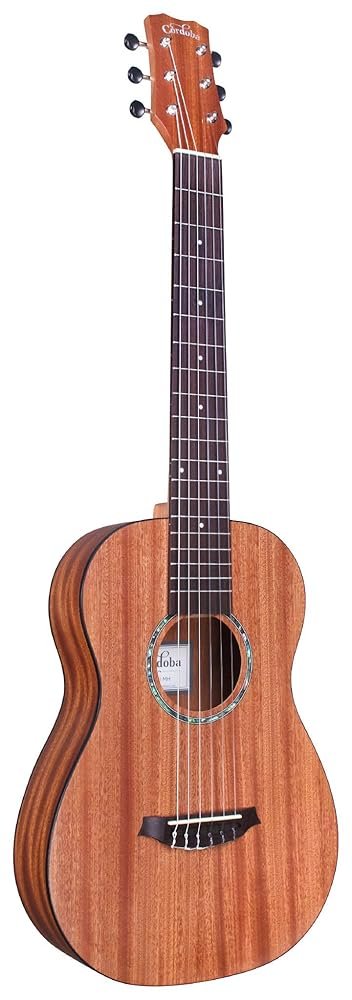
- Cordoba Mini II M. A small body nylon string with a 22.875 inch scale and a C profile mahogany neck, tuned to standard pitch rather than a transposed tuning. A strong option if you want nylon strings without a classical guitar’s very wide nut.
- Oscar Schmidt OG1P-A. A 3/4 size dreadnought described as suited to beginners, children, and players with smaller hands, and light enough to handle comfortably. A straightforward first steel string.
- Ibanez RG MiKro. A short scale electric with a 22.2 inch neck and high output Infinity R pickups, built to the same standard as the full size models. The pick for a small handed player who wants a real rock guitar rather than a scaled down toy.
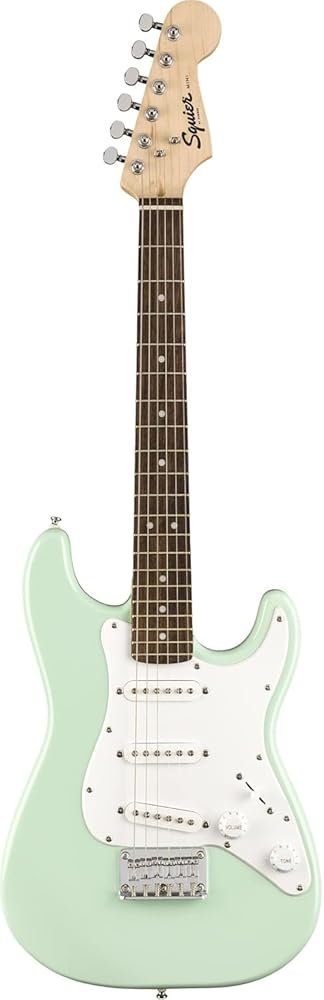
- Squier Mini Stratocaster. A compact Strat with a lightweight poplar body, an easy to play C shaped neck, three single coils with five way switching, and a hardtail bridge. Suits smaller players who want familiar Stratocaster tones.
You can compare more options in the acoustic guitars and electric guitars sections, or search the full review library.
Common questions
Are small hands a real disadvantage on guitar?
They make certain stretches harder, particularly wide chord voicings low on the neck. They are not a limit on how well you can play. Most of the gap closes through instrument choice, a good setup, and proper thumb position.
Should an adult with small hands buy a 3/4 size guitar?
It is a reasonable option, and many adults use them for travel and sofa practice. Bear in mind that a 3/4 body also produces less volume and less low end. A full size guitar with a short scale and a slim neck often gives you the comfort without that trade off.
Do nylon strings help small hands?
Nylon strings are softer under the fingertips, which helps with soreness. Classical guitars usually have much wider necks though, so the reach gets harder even as the pressure gets easier. A small body nylon string with a narrower neck is the way to get both benefits, and nylon versus steel string guitars goes through the full comparison.
Will barre chords ever get easier?
Yes. Barre chords depend far more on finger strength, thumb placement, and action height than on hand size. Lower the action, use lighter strings while you build up, and practise the shape at the fifth fret where the spacing is narrower before moving down to the first.